

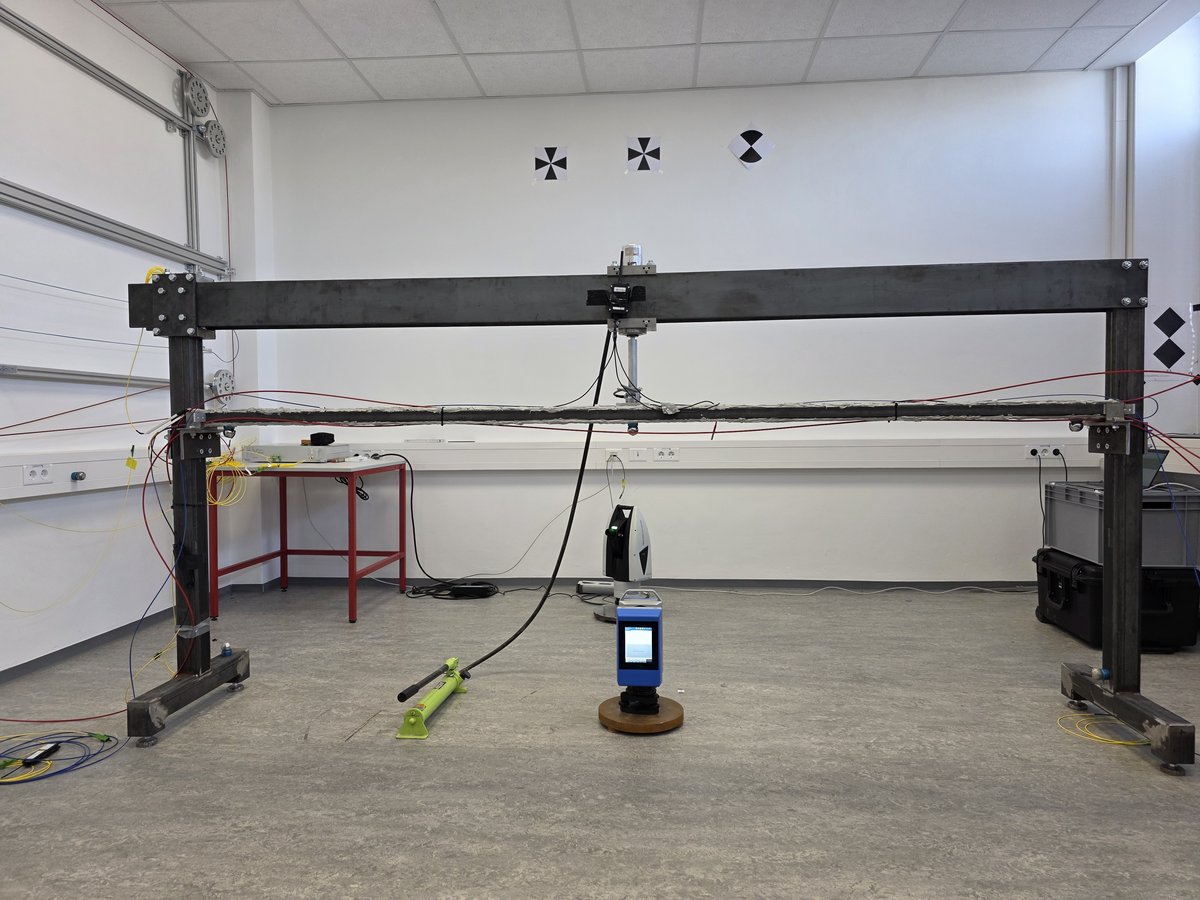
Test rig for scaled load tests
Integrated Deformation Monitoring of a Simply Supported Beam
An improved understanding of the performance of civil structures under static and dynamic loading, and through accurate and reliable spatio-temporal modeling with adequate resolution is of great importance in structural health monitoring (SHM). It enables comprehensive observation of structural responses and helps to prevent early-stage structural failures.
In this study, a test rig for scaled load tests was developed, consisting of a simply supported beam, which is deformed by hydraulic loading. The rig allows forces to be applied at different positions along the beam. Potential extensions include simulating multi-span bridge behavior or applying dynamic vertical loads. During quasi-static hydraulic loading, temperature and strain were continuously monitored using distributed fiber-optic sensing (DFOS) based on Rayleigh and Brillouin backscattering. In case of Rayleigh backscattering, the optical frequency domain reflectometry (OFDR) technique is used to interpret the signal from the fiber-optic cable with a spatial resolution in 1 mm level. Whereas, for the Brillouin backscattering, the Brillouin optical frequency domain analysis (BOFDA) technique is used to interpret the signal from the fiber-optic cable with a spatial resolution in the range of 200 mm. Strain measurements were obtained utilizing a Fibrasens strain cable. A Solifos BRUsens temperature cable was used to separate temperature-induced effects from the Fibrasens measurements, thereby enabling correction of the strain values.
The beam deflection was measured by a terrestrial laser scanner (TLS) of type Zoller+Fröhlich IMAGER 5016A in profile mode, i.e., profile laser scanning (PLS). This results in 2D profile data of the vertical deflection with a high spatio-temporal resolution of up to 55 Hz in 1 mm range. A B-spline curve approximation was applied to the 2D profile data to derive a continuous 2D deflection profile. Correlations between DFOS-based strain and temperature, PLS-based deflection, and hydraulic load were analyzed, enabling prediction of deflection–strain behavior under specific loads and identification of potential abnormal strain responses.
For validation, a laser tracker was used to perform high-accuracy measurements at the point of maximum deflection. It further supports an in-depth analysis and statistical judgement of the DFOS-based strain measurements. Moreover, the deflection curves derived from DFOS-based strain measurements were compared with deflection curves estimated from PLS using TLS and laser tracker measurements.
This integrated monitoring approach provides a comprehensive assessment of structural responses under load conditions, supporting detailed evaluation of the beam behavior and validation of experimental and numerical models. The proposed multimodal monitoring framework enables the establishment of baseline deflection–strain relationships under controlled loading, providing a foundation for detecting abnormal structural responses in future civil engineering applications.

Weitere Information
- Masterarbeit Leonhard Pleuger
Förderung
IGE intern